
Combined Surveys for Metal Detection with the DUALEM-1S and a Magnetometer
Both electromagnetic (EM) and magnetic surveys are used routinely for the detection of buried metal and metallic minerals. However, the magnetic field transmitted by an EM instrument can interfere with a magnetometer, and the interference becomes more problematic as the size and power-spectrum of the EM-transmitter increase. The DUALEM-1S has a compact, narrow-band transmitter. The following note describes the suitability of the DUALEM-1S for metal detection, and its compatibility with a magnetometer.
Metal Detection with the DUALEM-1S
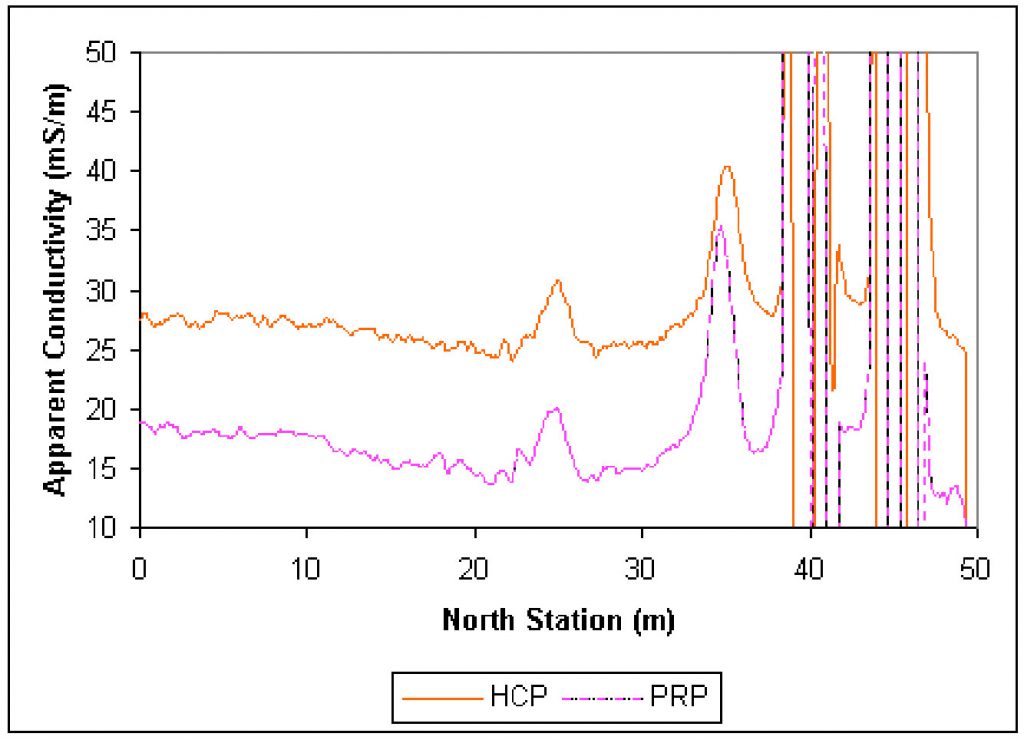
The stability of the DUALEM-1S has made it applicable to a variety of demanding EM surveys, such as monitoring moisture and nutrient fluctuations in cultivated fields. To demonstrate the application of the DUALEM-1S to metal detection, the instrument was pulled in a sled over Line 4 E at the Columbia Test Site of the University of Waterloo. Four 200-L (0.6-m diameter by 0.9-m length) steel drums are buried in an upright position beneath Line 4 E. The following table gives the stations at which the drums are buried, and the depth to the top of each drum.
| Station | Depth to Top |
| 25 N | 2 m |
| 35 N | 1.5 m |
| 40 N | 1 m |
| 45 N | 0.5 m |
Figure 1 shows the DUALEM-1S conductivity (quadrature) measurements for Line 4 E. The DUALEM-1S clearly identified the location of each drum with a distinctive peak in apparent conductivity. The fluctuations over the drums at 0.5- and 1-m are too great for the scale of Figure 1, respectively ranging in the thousands and hundreds of mS/m.
In addition to metal detection, the apparent conductivities also provide reliable indications of the ground conductivity to distinct depths. Conductivity measurements can be useful in a variety of situations, for example, where conductive contaminants are associated with the buried metal. The DUALEM-1S also provides in-phase measurements with amplitudes that are typically stronger than conductivities over buried metal, but soil with variable magnetic susceptibility can frustrate the interpretation of in-phase data.
Compatibility with a Magnetometer
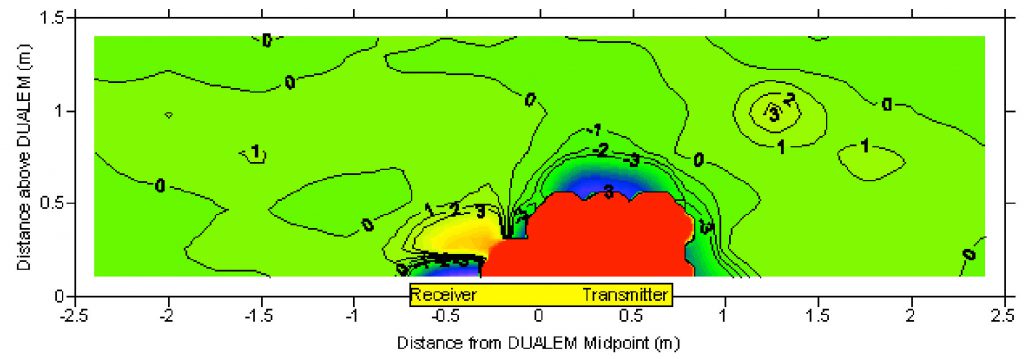
The DUALEM-1S transmits a magnetic field that can strongly affect the accuracy of a magnetometer. To determine the extent of this interference, a Scintrex SMARTMAG SM-4 cesium magnetometer was used to measure the intensity of the magnetic field for several m to either end of and above an operating DUALEM-1S, and to measure the intensity over the same area with the DUALEM-1S absent. Fluctuations in the earth’s magnetic field were removed by subtracting measurements made with a Scintrex base-station magnetometer.
Figure 2 shows the difference in the magnetic field caused by the operating DUALEM-1S. The intensity ranges over tens-of-thousands of nT but, for purposes of clarity, only the contours from -3 nT to 3 nT are shown. Allowing for a noise level about 1 nT, the DUALEM-1S has no effect on the magnetometer if the magnetometer is located at least 0.8 m from the transmitter of the DUALEM-1S, and at least 0.5 m from the remainder of the instrument.
Conclusions
At a practical separation of 0.5- to 1-m, the DUALEM-1S and a Cs-vapor magnetometer can be used for combined EM and magnetic surveys. The high and complementary sensitivities of these instruments provide reliable results with less ambiguity than a survey with either instrument alone, and their compatibility makes combined surveys economically attractive.
Dualem Products
DUALEM products are used by companies and universities on every continent. Our products fulfill a variety of use-cases in industry and academia.