
DUALEM Products
A DUALEM sensor (Sensor) incorporates one-, two- or three-sets of the patented DUALEM dual-geometry array. Each dual-geometry array simultaneously measures both electrical conductivity and magnetic susceptibility to two distinct and defined depths. Multiple sets of arrays enable the estimation of the distribution of these properties in a layered earth.
A Sensor measures electromagnetic (EM) responses, temperature, power voltage, and pitch and roll. An internal GPS receiver is standard; if there is a GPS fix the Sensor outputs NMEA $GPGGA sentences.
Sensors operate by EM induction into the earth (i.e. not by galvanic contact with the ground). This enables surveying at moderate speed over rough, non-conductive terrain, such as bedrock, pavement, stones, desiccated soil, dense vegetation and ice.
Sensors are calibrated precisely at the factory using a patented technique, eliminating the limitations of ad hoc calibrations in the field. Precise calibration, base-level stability, high sensitivity and advanced digital signal processing give the Sensors unmatched accuracy.
Sensors can be used with control-, positioning- and support-systems supplied by the user. LED lights indicate the status of power and communication. Sensors have a Wi-Fi webpage-style interface and provide measurement output in time-stamped CSV-format sentences through their Wi-Fi and RS-232 ports.
Sensors are typically mounted on a sled or cart. They are weatherproof, and can be deployed in a watertight housing. A Sensor comes with a data/power cable and PDF manual in a shipping case.
For hand-carried surveys, a DUALEM instrument (e.g. the DUALEM-1) combines a Sensor (e.g. the DUALEM-1S), a Controller and a Harness.
The handheld Controller communicates with its Sensor by Bluetooth and with the internet by Wi-Fi. Its Dualem app displays data and GPS position, and logs positioned data. It has a weatherproof cover, and can receive supplementary power through its micro-USB port.
The Harness facilitates carrying the Sensor for walking-speed surveys, and its rectangular feet help with alignment in station-by-station surveys. Its data/power module has a 9-socket connector for RS-232 communication/adaptors and an 8-AA battery holder for power.
All DUALEM products can be shipped by popular parcel-express services. Please direct inquiries to Dualem Inc., at inbox@dualem.com
Product List
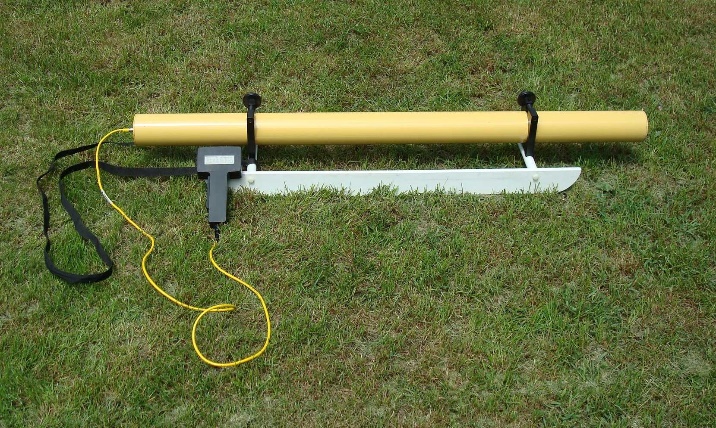
DUALEM-1S bolted to plastic sled
DUALEM-1 and DUALEM-1S
The DUALEM-1 has 1-m separation between its transmitter and dual receivers, so its dual depths of conductivity measurement are 0.5 m and 1.6 m (by the 70-% cumulative-sensitivity guideline). In-phase measurements sound magnetic susceptibility and detect metal.
The DUALEM-1 depths of measurement are ideal for many agricultural applications, and spatial resolution that is well suited to archaeological investigation. For metal detection, the DUALEM-1 can detect a steel drum to a depth of about 1 m.
The compact size of the DUALEM-1 makes it convenient for towing on a sled or carrying from station-to-station for on-ground measurements. The DUALEM-1S sensor is available separately at lower price for integration with the user’s own surveying systems.
| Feature | Description |
|---|---|
| EM Arrays | 1-m horizontal co-planar (HCP) and perpendicular (PRP) transmitter-receiver arrays, operating at 9 kHz |
| Measured EM Quantities | HCP apparent conductivity and in-phase PRP apparent conductivity and in-phase |
| Measuring Ranges | Conductivity: -1000 to +1000 mS/m, 0.1 mS/m resolution In-phase: -300 to +300 ppt, 0.01 ppt resolution |
| Data Rates | 1 Hz standard, optional rates include 0.1-, 5- and 10-Hz |
| Integrated Components | Digital signal processor, GPS receiver, indicator LEDs, RS-232 port, thermometers, Wi-Fi transceiver |
| Power | 8- to 16-V DC from harness module or external battery, draw about 3 W |
| Operating Dimensions | 0.089-m diameter, 1.41-m length (3.5” by 56”) |
| Operating Weights | 5 kg operating for DUALEM-1S, 7 kg for DUALEM-1 |
| Shipping Dimensions | 1.6m x 0.2m x 0.2m |
| Shipping Weights | 8 kg for DUALEM-1S, 12 kg for DUALEM-1 |
| Ancillary Items | Data/power cable, software and documentation, shipping tube. DUALEM-1 has a Bluetooth transceiver, controller and harness in a shipping box |

DUALEM-1H
DUALEM-1H and DUALEM-1HS
The DUALEM-1H has dual-geometry receivers at separations of 1- and ½-m from the transmitter, which provide simultaneous 0.3-, 0.5-, 0.8- and 1.6-m depths of conductivity sounding (by the 70-% cumulative-sensitivity guideline), four simultaneous in-phase (susceptibility) measurements, and metal detection.
The multiple sounding-depths of the DUALEM-1H enable the analysis of layering in the top 2-m of the earth.
The depth range and spatial resolution of the DUALEM-1H are ideal for many agricultural and archaeological applications. The compact size of the DUALEM-1H makes it convenient for towing on a sled or carrying from station-to-station for on-ground measurements. The DUALEM-1HS sensor is available separately at lower price for integration with the user’s own surveying systems.
| Feature | Description |
|---|---|
| EM Arrays | 0.5- and 1-m horizontal co-planar (HCP) and perpendicular (PRP) transmitter-receiver arrays, operating at 9 kHz |
| Measured EM Quantities | HCP apparent conductivity and in-phase PRP apparent conductivity and in-phase |
| Measuring Ranges | Conductivity: -1000 to +1000 mS/m, 0.1 mS/m resolution In-phase: -300 to +300 ppt, 0.01 ppt resolution |
| Data Rates | 1 Hz standard, optional rates include 0.1-, 5- and 10-Hz |
| Integrated Components | Digital signal processor, GPS receiver, indicator LEDs, RS-232 port, thermometers, Wi-Fi transceiver |
| Power | 8- to 16-V DC from harness module or external battery, draw about 3 W |
| Operating Dimensions | 0.089-m diameter, 1.59-m length (3.5” by 62”) |
| Operating Weights | 5 kg operating for DUALEM-1HS, 7 kg for DUALEM-1H |
| Shipping Dimensions | 1.7m x 0.2m x 0.2m |
| Shipping Weights | 9 kg for DUALEM-1HS, 12 kg for DUALEM-1H |
| Ancillary Items | Data/power cable, software and documentation, shipping tube. DUALEM-1H has a Bluetooth transceiver, controller and harness in a shipping box |

DUALEM-21S in survey platform built by Aarhus Universitet
DUALEM-21 and DUALEM-21S
The DUALEM-21 has dual-geometry receivers at separations of 2- and 1-m from the transmitter, which provide simultaneous 0.5-, 1-, 1.6- and 3.2-m depths of conductivity sounding, four simultaneous in-phase (susceptibility) measurements, and metal detection.
The multiple sounding-depths of the DUALEM-21 enable the analysis of layering in the top 4-m of the earth.
The DUALEM-21 can be carried on prolonged surveys by a single operator, and is suitable for towing on a sled or low cart. The DUALEM-21S sensor is available separately at lower price for integration with the user’s own surveying systems.
| Feature | Description |
|---|---|
| EM Arrays | 1- and 2-m horizontal co-planar (HCP) and perpendicular (PRP) transmitter-receiver arrays, operating at 9 kHz |
| Measured EM Quantities | HCP apparent conductivity and in-phase PRP apparent conductivity and in-phase |
| Measuring Ranges | Conductivity: -1000 to +1000 mS/m, 0.1 mS/m resolution In-phase: -300 to +300 ppt, 0.01 ppt resolution |
| Data Rates | 1 Hz standard, optional rates include 0.1-, 5- and 10-Hz |
| Integrated Components | Digital signal processor, GPS receiver, indicator LEDs, RS-232 port, thermometers, Wi-Fi transceiver |
| Power | 8- to 16-V DC from harness module or external battery, draw about 3 W |
| Operating Dimensions | 0.089-m diameter, 2.41-m length (3.5” by 95”) |
| Weights | 8 kg operating, 24 kg shipping |
| Shipping Dimensions | 2.55m x 0.18m x 0.18 m |
| Ancillary Items | Data/power cable, software and documentation, hinged metal case. DUALEM-21 has a Bluetooth transceiver, controller and harness |

DUALEM-21H and DUALEM-21HS
The DUALEM-21H has dual-geometry receivers at separations of 2-, 1- and ½-m from the transmitter, which provide simultaneous 0.3-, 0.5-, 0.8-, 1-, 1.6- and 3.2-m depths of conductivity sounding, six simultaneous in-phase (susceptibility) measurements, and metal detection.
The multiple sounding-depths of the DUALEM-21H enable the analysis of layering in the top 4-m of the earth.
The DUALEM-21H can be carried on prolonged surveys by a single operator, and is suitable for towing on a sled or low cart. The DUALEM-21HS sensor is available separately at lower price for integration with the user’s own surveying systems.
| Feature | Description |
|---|---|
| EM Arrays | ½-, 1- and 2-m horizontal co-planar (HCP) and perpendicular (PRP) transmitter-receiver arrays, operating at 9 kHz |
| Measured EM Quantities | HCP apparent conductivity and in-phase PRP apparent conductivity and in-phase |
| Measuring Ranges | Conductivity: -1000 to +1000 mS/m, 0.1 mS/m resolution In-phase: -300 to +300 ppt, 0.01 ppt resolution |
| Data Rates | 1 Hz standard, optional rates include 0.1-, 5- and 10-Hz |
| Integrated Components | Digital signal processor, GPS receiver, indicator LEDs, RS-232 port, thermometers, Wi-Fi transceiver |
| Power | 8- to 16-V DC from harness module or external battery, draw about 3 W |
| Operating Dimensions | 0.089-m diameter, 2.59-m length (3.5” by 102”) |
| Weights | 9 kg operating, 26 kg shipping |
| Shipping Dimensions | 2.70m x 0.18m x 0.18m |
| Ancillary Items | Data/power cable, software and documentation, hinged metal case. DUALEM-21H has a Bluetooth transceiver, controller and harness |

4-m DUALEM sensor on a simple raft
DUALEM-4 and DUALEM-4S
The DUALEM-4 has 4-m separation between its transmitter and dual receivers, so its dual depths of conductivity measurement are 2 m and 6.4 m (by the 70-% cumulative-sensitivity guideline). In-phase measurements sound magnetic susceptibility and detect metal.
4-m DUALEM sensors can be carried by one person with sufficient strength; padding between the sensor and carrier can improve comfort. Alternatively, the harness can be split for 2 people to carry the sensor.
The DUALEM-4S sensor is available separately at lower price for integration with the user’s own surveying systems. Towing on a sled optimizes spatial and geophysical resolution, but a low cart is a typical platform for surveying.
| Feature | Description |
|---|---|
| EM Arrays | 4-m horizontal co-planar (HCP) and perpendicular (PRP) transmitter-receiver arrays, operating at 9 kHz |
| Measured EM Quantities | HCP apparent conductivity and in-phase PRP apparent conductivity and in-phase |
| Measuring Ranges | Conductivity: -1000 to +1000 mS/m, 0.1 mS/m resolution In-phase: -300 to +300 ppt, 0.01 ppt resolution |
| Data Rates | 1 Hz standard, optional rates include 0.1-, 5- and 10-Hz |
| Integrated Components | Digital signal processor, GPS receiver, indicator LEDs, RS-232 port, thermometers, Wi-Fi transceiver |
| Power | 8- to 16-V DC from harness module or external battery, draw about 3 W |
| Operating Dimensions | 0.089-m diameter, 4.41-m length (3.5” by 173”) |
| Weights | 15 kg operating, 34 kg shipping |
| Shipping Dimensions | 2.55m by 0.30m by 0.15m |
| Ancillary Items | Data/power cable, software and documentation, hinged metal case. DUALEM-4 has a Bluetooth transceiver, controller and harness |
DUALEM-421 and DUALEM-421S
The DUALEM-421 has dual-geometry receivers at separations of 4-, 2- and 1-m from the transmitter, which provide six simultaneous depths of conductivity sounding, six simultaneous depths of susceptibility sounding, and detection of metal.
The variety of sounding depths makes the DUALEM-421 ideal for the analysis of the thickness, conductivity and susceptibility of layering in the top several metres of the earth.
4-m DUALEM sensors can be carried by one person with sufficient strength; padding between the sensor and carrier can improve comfort. Alternatively, the harness can be split for 2 people to carry the sensor.
The DUALEM-421S sensor is available separately at lower price for integration with the user’s own surveying systems. Towing on a sled optimizes spatial and geophysical resolution, but a low cart is a typical platform for surveying. The DUALEM-421S disassembles to form a DUALEM-21S.
| Feature | Description |
|---|---|
| EM Arrays | 1-, 2- and 4-m horizontal co-planar (HCP), 1.1- 2.1- and 4.1-m perpendicular (PRP) transmitter-receiver arrays, operating at 9 kHz |
| Measured EM Quantities |
|
| Measuring Ranges | Conductivity: -1000 to +1000 mS/m, 0.1 mS/m resolution In-phase: -300 to +300 ppt, 0.01 ppt resolution |
| Data Rates | 1 Hz standard, optional rates include 0.1-, 5- and 10-Hz |
| Integrated Components | Digital signal processor, GPS receiver, indicator LEDs, RS-232 port, thermometers, Wi-Fi transceiver |
| Power | 8- to 16-V DC from harness module or external battery, draw about 3 W |
| Operating Dimensions | 0.089-m diameter, 4.41-m length (3.5” by 173”) |
| Weights | 15 kg operating, 34 kg shipping |
| Shipping Dimensions | 2.55m x 0.30m x 0.15m |
| Ancillary Items | Data/power cable, software and documentation, hinged metal case. DUALEM-421 has a Bluetooth transceiver, controller and harness |
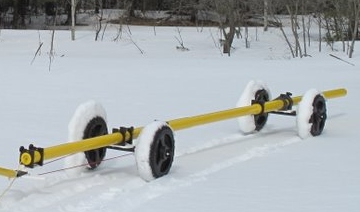
DUALEM-642 with clamped-on wheels and yoke
DUALEM-642 and DUALEM-642S
The DUALEM-642 has dual-geometry receivers at separations of 2-, 4- and 6-m from the transmitter, which provide six simultaneous depths of conductivity sounding, six simultaneous depths of susceptibility sounding, and detection of metal.
The variety of sounding depths makes the DUALEM-642 ideal for the analysis of the thickness, conductivity and susceptibility of layering to 9-m depth. The harness can be used by 2 people to carry the sensor.
The DUALEM-642S sensor is available separately at lower price for integration with the user’s own surveying systems. A low cart is a suitable platform for surveying. The DUALEM-642S disassembles to form a DUALEM-42S or DUALEM-2S.
| Feature | Description |
|---|---|
| EM Arrays | 2-, 4- and 6-m horizontal co-planar (HCP), 2.1- 4.1- and 6.1-m perpendicular (PRP) transmitter-receiver arrays, operating at 9 kHz |
| Measured EM Quantities |
|
| Measuring Ranges | Conductivity: -1000 to +1000 mS/m, 0.1 mS/m resolution In-phase: -300 to +300 ppt, 0.01 ppt resolution |
| Data Rates | 1 Hz standard, optional rates include 0.1-, 5- and 10-Hz |
| Integrated Components | Digital signal processor, GPS receiver, indicator LEDs, RS-232 port, thermometers, Wi-Fi transceiver |
| Power | 8- to 16-V DC from harness module or external battery, draw about 3 W |
| Operating Dimensions | 0.089-m diameter, 6.41-m length (3.5” by 252”) |
| Weights | 20 kg operating, 40 kg shipping |
| Shipping Dimensions | Two cases:
|
| Ancillary Items | Data/power cable, software and documentation, hinged metal case. DUALEM-21 has a Bluetooth transceiver, controller and harness |
DUALEM-842 and DUALEM-842S
The DUALEM-842 has dual-geometry receivers at separations of 2-, 4- and 8-m from the transmitter, which provide six simultaneous depths of conductivity sounding, six simultaneous depths of susceptibility sounding, and detection of metal.
The variety of sounding depths makes the DUALEM-842 ideal for the analysis of the thickness, conductivity and susceptibility of layering to 13-m depth. The harness can be used by 2 people to carry the sensor.
The DUALEM-642S sensor is available separately at lower price for integration with the user’s own surveying systems. A low cart is a suitable platform for surveying. The DUALEM-842S disassembles to form a DUALEM-42S or DUALEM-2S.
| Feature | Description |
|---|---|
| EM Arrays | 2-, 4- and 8-m horizontal co-planar (HCP), 2.1- 4.1- and 8.1-m perpendicular (PRP) transmitter-receiver arrays, operating at 9 kHz |
| Measured EM Quantities |
|
| Measuring Ranges | Conductivity: -1000 to +1000 mS/m, 0.1 mS/m resolution In-phase: -300 to +300 ppt, 0.01 ppt resolution |
| Data Rates | 1 Hz standard, optional rates include 0.1-, 5- and 10-Hz |
| Integrated Components | Digital signal processor, GPS receiver, indicator LEDs, RS-232 port, thermometers, Wi-Fi transceiver |
| Power | 8- to 16-V DC from harness module or external battery, draw about 3 W |
| Operating Dimensions | 0.089-m diameter, 8.41-m length (3.5” by 331”) |
| Weights | 25 kg operating, 68 kg shipping |
| Shipping Dimensions | Two cases:
|
| Ancillary Items | Data/power cable, software and documentation, hinged metal case. DUALEM-21 has a Bluetooth transceiver, controller and harness |

DUALEM devices can be controlled with Android smartphones
Controller with GPS and harness with data/power module
The basis of the Controller is the Dualem app. Dualem sells the app with user credentials preinstalled on an Android smartphone; the Controller also has a weatherproof cover. The adjacent picture shows such a Controller. The picture also shows a portion of a Harness with data/power module.
After the purchase of the user credentials for the app for a given sensor, the owner can download the latest version of the Dualem app from Google Play to any suitable Android device for potential use with that sensor.
An Android device running the Dualem app communicates with the sensor by Bluetooth, and to the internet by Wi-Fi (or by other means, e.g. mobile data-service, supplied by the user). The app can display Google Maps (if available) and the survey track, log sensor output with GPS positioning from the device to a comma-separated-values (CSV) file, and upload files to the internet using Gmail, Google Drive, or Dropbox.
The Harness with data/power module features rectangular feet that clamp to the sensor using non-conductive fasteners, a guard and sleeve to protect the cable from the sensor to the data/power module, and the module with (i) a standard 9-socket serial-port connector and (ii) a holder for 8 AA-batteries; the module hangs closely beneath the carrying strap of the harness. A Harness for a 4-m-or-longer sensor also has padded shoulder straps. A Double Harness, comprising of a standard 4-m Harness plus a simple harness (without guard, sleeve or module) for a second person might be preferred for a 4-m-or-longer sensor.
Dualem Products
DUALEM products are used by companies and universities on every continent. Our products fulfill a variety of use-cases in industry and academia.